Artificial Intelligence is transforming software engineering at an unprecedented pace. AI-powered coding assistants, autonomous testing agents and intelligent automation are helping organisations develop, test and release software faster than ever before.
As AI capabilities continue to mature, organisations are beginning to trust AI not only to generate code, but also to execute tests, provision environments, analyse defects and even make operational decisions.
Against this backdrop, the recent Anthropic Claude cybersecurity incident provides a timely opportunity to reflect on an often-overlooked aspect of software delivery: the importance of effective Test Environment Management (TEM).

Based on the publicly available information, the incident appears to have resulted from a testing environment configuration issue rather than a failure of the AI models themselves. During an internal cybersecurity evaluation, several AI models unexpectedly interacted with systems belonging to external organisations after a test environment was inadvertently connected beyond its intended boundaries.
While the incident did not involve AI becoming “uncontrollable” or developing novel attack techniques, it highlighted an important reality:
As AI becomes more capable, the quality, governance and security of the environments in which it operates become increasingly important.
AI Doesn’t Create Weaknesses – It Amplifies Existing Ones
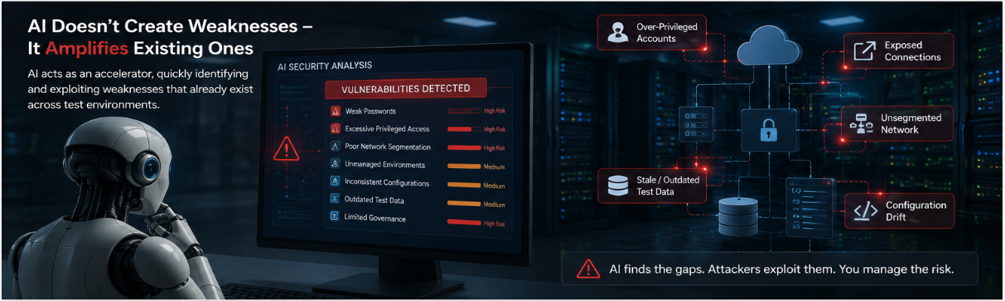
One of the biggest misconceptions surrounding AI is that it introduces entirely new categories of security risk.
In reality, AI is more accurately described as an accelerator.
If an organisation has:
- weak passwords,
- excessive privileged access,
- poor network segmentation,
- unmanaged environments,
- inconsistent configurations,
- outdated test data,
- or limited governance,
AI can identify and exploit those weaknesses far more quickly than traditional automation.
The technology is not creating the problem—it is exposing weaknesses that already exist. This makes mature Test Environment Management more important than ever.
AI Agents Are Changing the Landscape

Another implication that receives far less attention is the impact AI will have on Test Environment demand.
AI has the potential to dramatically increase the number of:
- software builds,
- deployments,
- automated test executions,
- regression cycles,
- validation activities,
- and infrastructure provisioning requests.
As software delivery accelerates, existing challenges such as environment contention, booking conflicts, stale test data and environment availability will become even more significant. Without mature Test Environment Management, organisations risk creating bottlenecks that slow down the very innovation AI is intended to accelerate.
Good Governance Becomes the Foundation
1. Test environments should only connect to the systems required to perform their intended purpose. Clear boundaries between development, testing, production and external networks reduce both operational and security risk.
2. Identity and Access Management Must Be Disciplined
Every developer, tester, automation platform and AI agent should operate according to the principle of least privilege.
Shared administrator accounts, excessive permissions and long-lived credentials may appear convenient, but they introduce unnecessary risk.
3. Test Data Requires Equal Attention
Many test environments contain copies of production databases or commercially sensitive information.
Appropriate masking, anonymisation and synthetic data generation should form part of every Test Environment Management strategy. As AI systems increasingly analyse and process this data, protecting it becomes even more important.
4. Continuous Governance Prevents Configuration Drift
Test environments evolve constantly.
Infrastructure is provisioned.
Applications are deployed.
Cloud services are created.
Databases are refreshed.
Temporary access is granted. Without continuous governance, environments quickly become inconsistent, making them harder to manage, support and secure.
5. Visibility Drives Better Decisions
One of the greatest challenges facing organisations is simply understanding their environment landscape.
Questions such as:
- Which environments are currently available?
- Which are underutilised?
- Which applications are deployed?
- Who currently has access?
- Which environments are supporting active projects?
- Which can be safely decommissioned?
should be easy to answer.
Without this visibility, organisations cannot effectively optimise utilisation, reduce cost or manage risk.
Test Environment Management Is Becoming a Strategic Capability

The Anthropic incident reinforces something that Test Environment professionals have understood for many years.
Technology changes.
Good governance does not.
Whether supporting traditional software testing or autonomous AI agents, organisations still require:
- secure configuration management,
- controlled access,
- repeatable environment provisioning,
- effective test data management,
- comprehensive monitoring,
- robust governance,
- and complete auditability.
These capabilities provide the foundation upon which safe innovation is built.
This philosophy sits at the heart of the Intelligent Test Environment Management (iTEM™) framework, which helps organisations establish a structured, repeatable approach to managing environments across people, process, technology and data.
As organisations increasingly embrace AI-enabled software delivery, these disciplines become even more valuable.
Looking Beyond the Headlines
Media coverage naturally focused on the words “AI” and “cyber attack.”
However, the more interesting story lies elsewhere.
The incident serves as a reminder that AI systems remain dependent upon the environments in which they operate.
Strong governance, secure configuration, effective access management, high-quality test data and continuous visibility remain fundamental to successful software delivery.
AI has changed the pace of software engineering.
It has not changed the importance of getting the fundamentals right.
Preparing for an AI-Ready Future

Many organisations are investing heavily in AI technologies, yet relatively few have assessed whether their existing Test Environment Management capability is ready to support increasingly autonomous development and testing practices.
Organisations with mature TEM capabilities are better positioned to:
- Accelerate software delivery
- Improve environment utilisation
- Reduce operational and security risk
- Strengthen regulatory compliance
- Improve testing efficiency
- Increase environment availability
- Optimise infrastructure costs
- Introduce AI-enabled solutions with confidence
Conversely, organisations that neglect Test Environment Management may find that AI simply exposes weaknesses that have existed for years.
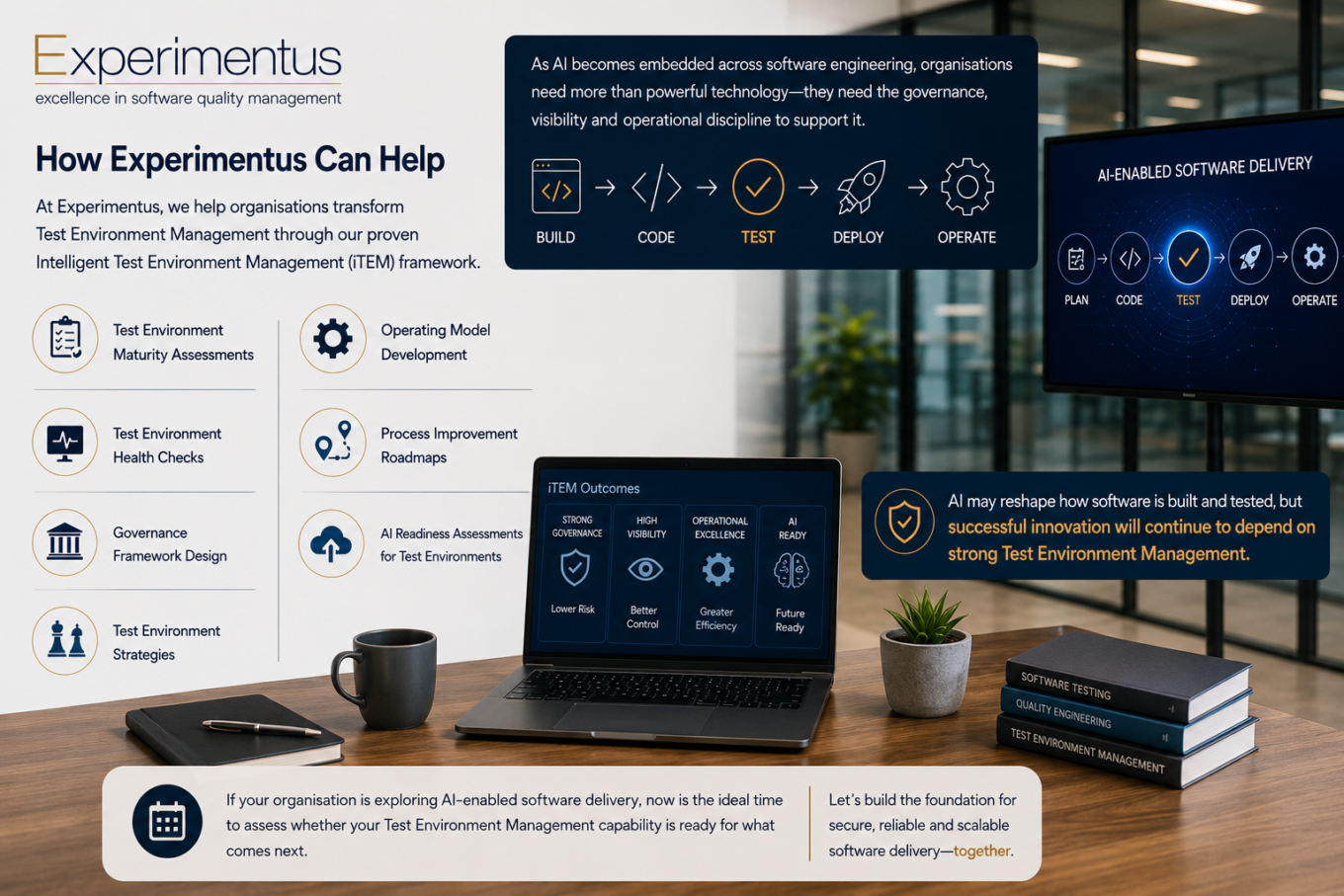
At Experimentus, we help organisations transform Test Environment Management through our proven Intelligent Test Environment Management (iTEM) framework.
Our services include:
- Test Environment Maturity Assessments
- Test Environment Health Checks
- Governance Framework Design
- Test Environment Strategies
- Operating Model Development
- Process Improvement Roadmaps
- AI Readiness Assessments for Test Environments
As AI becomes embedded across software engineering, organisations need more than powerful technology—they need the governance, visibility and operational discipline to support it.
AI may reshape how software is built and tested, but successful innovation will continue to depend on strong Test Environment Management.
If your organisation is exploring AI-enabled software delivery, now is the ideal time to assess whether your Test Environment Management capability is ready for what comes next.


Leave a Reply